Talking Adventure Travel and Cycling in Provence on Global News Radio’s “The Informed Traveler”

Cycling past sunflower field, Provence

Adventure tourism is one of the fastest-growing segments of the travel market – climbing by a whopping 65% a year from 2009 to 2013, and projected to grow by more than 17% annually through 2023.

According to a 2018 survey by Travel Leaders Group, it’s the top specialty travel choice among North American travellers, and sought out by men and women of every age group.

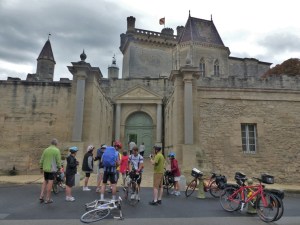
Outside the Fortress in UzesWhat exactly IS adventure travel?  According to the Adventure Travel Trade Association (ATTA), it’s travel that combines at least 2 out of the following three elements:  physical activity; connection with nature; interaction with culture.

“Soft” adventure activities like hiking, cycling, and kayaking are among the most popular, driven by travellers’ increased desire to include hands-on, authentic , and off-the-beaten-path experiences while out exploring the world.

I’m certainly no athlete,  but by this definition I’ve been a soft adventure traveller for two decades.  Given the statistics, you’ve likely done some, too, or are seriously considering it for future forays around the globe.

Listen to this week’s INFORMED TRAVELER podcast, as host Randy Sharman explores why I like to include a bit of active travel in my holiday plans.  You’ll hear some adventures from my multi-day cycling trip in France – through one of the most interesting corners of Provence – and learn tips about choosing a cycling tour that’s right for you.

The INFORMED TRAVELER is heard every Sunday at 8 am on NewsTalk770 Calgary , at 6 pm on Edmonton’s 630CHED, and at 3 pm on NewsTalk980 CKNW Vancouver.  Listen to it on your mobile device through CuriousCast.

Text and photos © 2019 Catherine Van Brunschot


Radio Interview on THE INFORMED TRAVELER: Talking about Tuscany

Thanks so much to Randy Sharman for inviting me to chat about Tuscany on the May 5 episode of his radio show, THE INFORMED TRAVELER.

I love the relaxed, conversational way that Randy’s show brings the latest in travel news and tips to his listeners.  Like me, he believes that “there’s no better learning experience than traveling the world and meeting the people who inhabit it”, and he’s dedicated to teasing out stories and insights from his on-air guests.

The INFORMED TRAVELER is heard Sunday’s on 770CHQR in Calgary, 630CHED in Edmonton and on 980 CKNW in Vancouver.

You can also listen to free podcast episodes on curiouscast.ca and omny.fm by searching Google Podcasts,  Apple Podcasts, or Spotify on your electronic device.

In the May 5 segment, Randy uses my City Palate article “Late to the Table: a Culinary Walk Through Italy” as a springboard for discussing why food is special in Tuscany and how best to explore the region’s culinary treasures.

You can listen to my segment here – or hear the full episode (including info on celebrating Cinco de Mayo in Los Cabos or volunteering abroad) on THE INFORMED TRAVELER website.  If you like what you hear, you’ll find past episodes available on the website, too.

I’m looking forward to chatting with Randy again sometime in the future!

Text and photos © 2019 Catherine Van Brunschot

Deep November

November Sunrise - Calgary

NOVEMBER IN CALGARY: it’s the perfect juxtaposition of dwindling daylight hours and increasing social expectations that’s destined to wreak havoc with your serenity.

Still, the silver lining of this time of year is witnessing a stunning prairie sunrise as you grab that first (or second!) morning coffee at work – and a mountain sunset as you make your commute home.

Those rose-hued skies of late have put me in mind of a couple of my favourite things to lighten the holiday season.

November Sky cocktail (Cirque Restaurant, Fernie, BC)
My rendition of the November Sky (Cirque’s is much prettier)

The first is the November Sky – a warming combination of brown spirits and red wine that is one of Aileen Shipley’s gifts to the cocktail-sipping community.  Shipley conjured it up for her apres-ski guests at Cirque Restaurant & Bar in Fernie’s Lizard Creek Lodge (and allowed me to share the recipe in my basil column last winter).  The cocktail’s evocative sweet and sour layers are up to the dual tasks of pleasing your holiday guests or lifting your spirits as you work through your seasonal checklist.

And my second favourite go-to? Broiled Feta Crumbles & Fennel on Mixed Micro-Greens – a quick and delicious topper for crostini or crackers that was taught to me by Chef Crystal McKenzie of Peasant Cheese Shop in Kensington.  The recipe for this appetizer inspiration has recently made its way to the website of Taste & Travel International where you can access it for yourself.

[You’ll notice T&T’s photo presents it plated like a salad – a delicious option – but Crystal likes to spread a thick layer of tiny sprouts (pea shoots are terrific!) across a small platter, then sprinkle the toasted cheese crumbles and roasted fennel bits across the top, for a layered ensemble that guests can simply scoop onto their bread].

Mmmm – warm, salty cheese and greens, together with an elevated whisky sour.  For me there’s no better combination for easy entertaining or a little self-care in the midst of holiday chaos.

Or for simply curling up and looking ahead to powder ski days in the Rockies.

Text and photos © 2018 Catherine Van Brunschot

A BeakerEats Preview

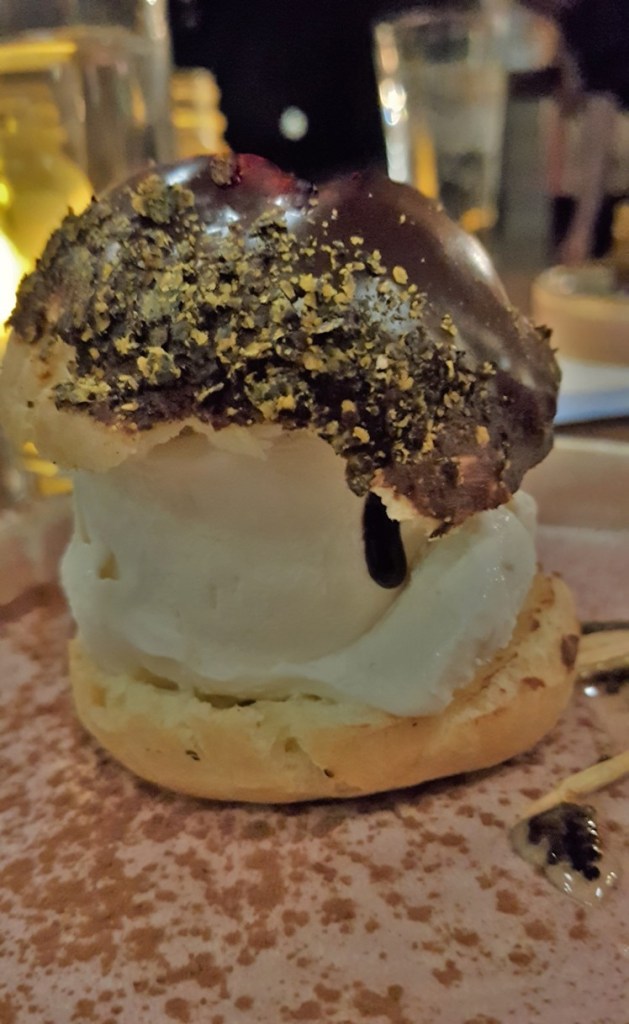
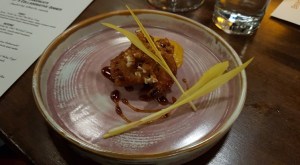
Toasted Canola Hay Gelato Profiterole

When your thoughts swing to gelato flavours, how often does canola appear on your  radar?

I’m going to go out on a limb here and guess:  never.

Fortunately, the mind of gelato guru Chef Mario Spina of Burger 320 holds no such limitations.

When the team behind Beakerhead – Calgary’s annual smash up of art, science, and engineering – dropped a load of canola hay, seeds, meal, and oil on his stoop, and asked him to produce an entry to this year’s BeakerEats program, he took up the challenge with gusto.  Notwithstanding a dramatic confrontation between his convection oven and the canola hay, Chef Spina came through with a toasted-canola-hay-infused gelato profiterole, topped with honey-chocolate sauce and a dusting of canola meal; a dessert that – judging by the moans of rapture emanating from my fellow diners – was right on the mark.

Canola sheafIt was the crowning finish to the BeakerEats Chefs’ Collaborative Dinner, a public event that previews some of the delights awaiting diners at participating restaurants throughout Beakerhead.  BeakerEats launches today, while the 2018 festival’s full lineup of activities, installations, talks and workshops – including a handful of culinary chemistry sessions – runs September 19 to 23.

Each year under its BeakerEats banner, the festival team selects a theme ingredient from Canadian farmers and producers, puts together a science kit of local products for Calgary chefs and mixologists, and challenges them to do what they do best:  apply their creativity to the fullest expression of outstanding ingredients.  The theme for 2018 is canola in all its forms – oil, seeds, meal, hay, and sprouts – a true prairie product grown by some 14,000 Alberta farmers.

As Beakerhead’s Paul Gordon noted at the outset of Wednesday’s dinner, canola itself has a long and interesting scientific history.  From its lowly origins as an inedible lubricant for the steam engines that powered Canada’s WWII navy, to its current position as one of the world’s healthiest edible oils (whose spent grain has also become a top-grade feed for dairy cattle), canola is a Canadian success story that speaks to the best of health-friendly science and to research both collaborative and tenacious.

Our BeakerEats walk through canola history was fueled by a Bloody Airdrie created by Spirit of the Wench, Wendy Peters.  It was a tasty tipple  that combined summer tomatoes, cucumbers, and red peppers with blended canola seed and Absolut Lemon vodka.

Bison Tataki

Then it was on to the tasting menu – and what a menu it was!

River Cafe‘s Chef Matthias Fong started us off with bison tataki, tucked cozily with Highwood Crossing canola oil sorbet and canola hay infused cream, and laced with Fallen Timbers mead, honey-crystallized canola seed,  and charred kohlrabi.

Brassica Family Salad


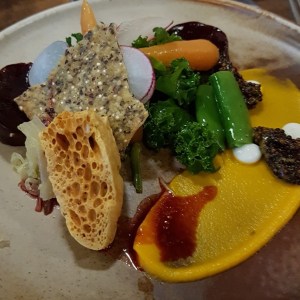
It was the perfect prelude to Chef Mitchell Carey’s Instagram-worthy salad of brassica-family vegetables, arranged with a cracker of spent canola & grains and honeycomb sponge toffee among pools of colourful canola infusions created by his Winebar Kensington team.

Spiced Canola Cake


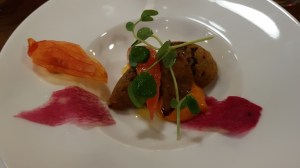
Next up were spicy morsels of canola seed cake, created by Chef Liana Robberecht of WinSport, with bitey Highwood Crossing confit tomatoes, ninja radish, tomato skin petals, and canola shoots.

Chef Mike Pigot brought his Home and Away crafting style to popcorn-and-canola-meal tempura shrimp, with drizzles of canola seed caramel and a brilliant canola aioli.

Beef Bavette


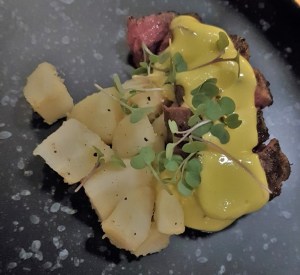
The main course was provided by the dinner’s host venue, Brasserie Kensington, and featured a canola-hay-smoked sous vide beef bavette created by Chef Jorel  Zielke, sided with ABC Farms honey & parsnip saute and cold-pressed canola hollandaise.

And finally, that dessert:  Chef Spina’s toasted-hay gelato, sandwiched between choux pastry layers made from a canola oil/butter blend.

I could wax endlessly about the tastes, textures, and stylings of the night’s creative offerings – but go try them yourself instead.  You’ll find each dish on the menu of its creator’s home restaurant, from now until the end of Beakerhead 2018.

Be sure to ask Chef Spina about his canola hay tribulations.

****************

Sample more BeakerEats cocktails and food features at these other participating restaurants:  The Coup, Deane House, Oxbow, Yellow Door Bistro, and Shokunin.  Two dollars is donated to Beakerhead for every BeakerEats dish and cocktail sold.

Find the full line-up of Beakerhead events here.

For insight into canola’s fascinating scientific history, check out this overview at wdm.ca or the resources at albertacanola.com

Text and photos © 2018 Catherine Van Brunschot

Privileged Travel

Kids in a Syrian refugee camp
Kids in a Syrian refugee camp (Used under Creative Commons License: Muhammed Muhelsen)

I have a special privilege when I travel.

I get to take home for granted.

I choose when to leave it.  It’s always there when I want to come back.

In a world where one in every 113 people have been forced to flee their homes because of war or persecution, that’s a rare privilege indeed.

Today on World Refugee Day, we recognize and celebrate the resilience and strength of those living in refugee camps and those struggling to create a new life in their adoptive countries.

While politicians and policy-makers wrangle about the best ways to address (or ignore) the refugee crisis, we can take time to understand the issues better.

Check out this video as you turn to FIFA World Cup today.

Check out these popular books by Canadian authors to supplement your summer reading.

Check out UNHCR Canada  for the full picture on refugees in the world today.  (Prepare to be overwhelmed).

And check out these stories and video clips (Soap and Starbucks) to find out what refugees are doing in Calgary, Victoria, and Surrey, BC.  (Prepare to be inspired).

#WithRefugees

It’s Back! Can you spell F-R-E-E —- L-U-N-C-H?

Feed the 5000 Calgary logoLast year’s inaugural Feeding the 5000 event in Calgary was such a huge success that it’s back for a second year.

Volunteers prepare vegetables

For those who missed it, Feeding the 5000 (#f5kyyc) sees local chefs, producers, food retailers, community organizations and a legion of volunteers come together to prepare a delicious lunch for five thousand people, using food that would otherwise be thrown away.

Think winter-stored potatoes, ugly onions, shelf-weary fruit, day-old bread…

That’s just a small part of the 1/3 of world food production that never makes it into people’s bellies – and that we Calgarians discard daily.  By turning donated leftovers into lunch instead of compost, SAIT Chef Andrew Hewson and his team will not only be rescuing edible food, but also saving from waste all the resources to grow, ship, and produce that food.

Greek salad – F5KYYC 2017

This year’s draft menu looks AMAZING:  potato salad with Brassica mustard vinaigrette; white bean salad with kale and herb pesto; rescued-fruit lemonade; and chocolate chip cookies made of spent grain from a local craft brewer.

The bread pudding with yogurt sauce that drew a long line of fans at last year’s event will be making an encore appearance.

F5KYYC bread pudding
Lining up for bread pudding – F5KYYC 2017

And that’s just for starters.  There are always surprises when the food trucks roll in – who knows what else will appear?

So leave your brown bag at home and your debit card in your pocket this Thursday, June 14, and come on down to Olympic Plaza between 10:30 am and 2 pm to taste what a little creativity (and a lot of hands) can do.

Chickpea salad - F5KYYC 2017
Chickpea salad – F5KYYC 2017

Check out the partner booths. Watch a food demo or two. Take away some new recipes for tackling your own food waste at home.

Last year’s event served 6,750 portions of a nutritious free lunch and diverted 1,025 kg of food from the landfill.  This year Feeding the 5000 Calgary is looking to beat that – so come early.  The event ends when the food runs out.

Feeding the 5000 Calgary

June 14, 2018

10:30 am to 2 pm

Olympic Plaza

Follow the event on Facebook,

 #f5kyyc and @f5kyyc.

Supported by The City of Calgary Waste and Recycling Services,

Leftovers Calgary, and the Recycling Council of Alberta 

with funding from Alberta Ecotrust.


Text and photos © 2018 Catherine Van Brunschot

A Calgary Kind of Craving

Peace Bridge, Calgary
Photo credit – D. Mulligan (via Creative Commons license)

You’d be forgiven if you didn’t know that Calgary is a great food town.  It’s kind of a well-kept secret.

Except to those who’ve been paying attention…

If Calgary hasn’t been on your radar for awhile, find out what you’ve been missing – and the best ways to (re)discover it – in my piece “A Calgary Kind of Craving” in the new issue of Taste & Travel International.

You can read the full story here – or check out the complete Spring Issue of Taste & Travel on Zinio, Pocket Mags, Flipster, PressReader (free from your local library), or with the new T&T app (available on iTunes and GooglePlay).

Passion for Perigord

Chefs Fudge and Meret depart Château Montastru
Photo credit – Steve Dunk

It’s 9:30 am and I’m elbow-deep in foie gras in a château in southwest France.  Not literally to the elbows, mind you, but I’m as up-close-and-personal as I’m likely to get, thrilled and terrified in equal measure as I tease vascular tissue free from the prized duck liver.  Despite the cooling armour of the castle’s thick walls, the foie gras seems to be melting under my fingers and I’m beginning to sweat.  My mentor, Chef Thierry Meret, reassures me with his usual bonhomie – and a shot of plum brandy.

Read the full story in the Winter 2018 Issue of Taste & Travel International magazine.

Leftovers Black Box Challenge – Week 4: The Excuse

Calgary Farmers' Market produce

I had great plans for this week.  Multiple leftovers challenges to address in my fridge.

But in the same way that life can derail even the best-laid plans to use up all the food we bring home, life has conspired to take me away from my kitchen.

It’s family commitments that are calling – both delightful and less so.  But the upshot is that I have to take an early hiatus from this blog series.   I’m not quite sure when I’ll return.

Hit the FOLLOW button on the sidebar if you want to get a notice when I’m back.

DO keep sending me your leftovers conundrums, questions, and tips.  I love to hear about your challenges and triumphs with your own Black Box.

Cheers ’til later,

Catherine

Text and photos © 2018 Catherine Van Brunschot

Black box

Leftovers Black Box Challenge – Week 2: Slaying your Dragons

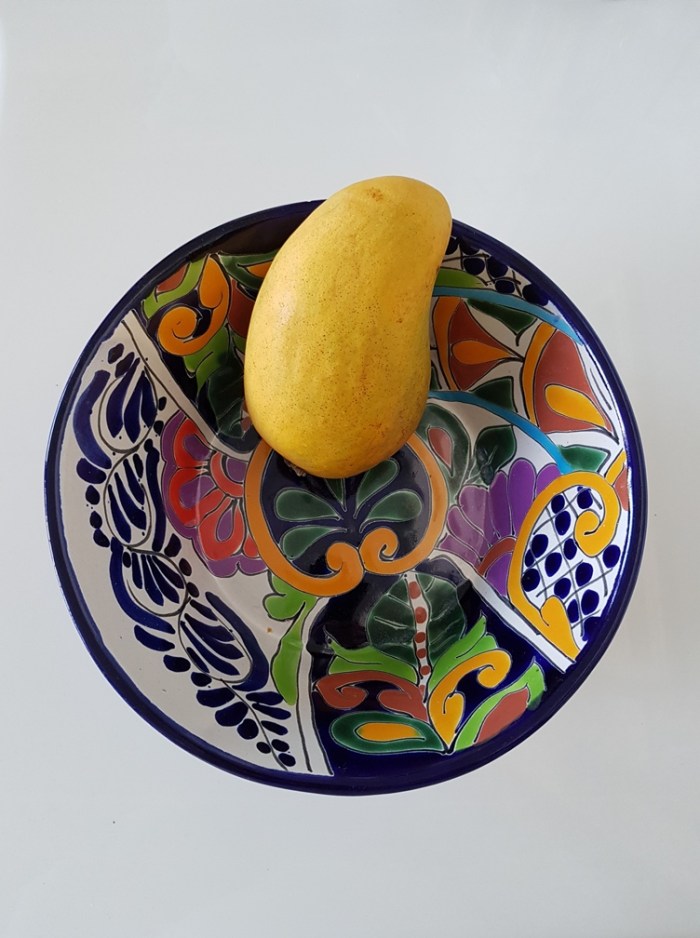
Ataulfo mango

They’re B-A-A-A-C-K!

Ataulfo mangoes.  They popped up this week in the supermarket, drawing my hand like bears to honey.  Their flesh was supple, their scent sweet.  Need I tell you that some of them ended up in my kitchen?

Those of you who have been following me for awhile will know of my irrational weakness for ataulfo mangos.  The fragrant golden fruits with their parrot-beak tops have become symbolic to me of all those impulsive purchases I’ve made at the grocery store or the farmers’ market with no plan as to how I’m going to use them.  They’re one of those things at high risk to shrivel away before I figure something out.  (Bet you know what yours are!)

But no worries.  This week the mangoes disappeared quickly.  One made it into a refreshing Mango Cucumber salad taught to me by Josefina Gonzalez Luigi of Cocina con Alma cooking school in Cozumel.  The others morphed into a creamy mango pudding from a Dairy Farmers of Canada ad lifted from a long-forgotten magazine.

They reminded me, though, of the importance of knowing my weaknesses and preparing a line of defence for them.  ( See #4 of my Food Lover’s Real Life Guide to Reducing Food Waste City Palate, Nov/Dec 2017).  I’ve learned to keep a stash of recipes for the things I know I’ll buy on impulse – and also for the things I throw out most often.

Food magazinesBut how to build this arsenal?

I’m a big reader of food magazines (no surprise there), so I routinely rip out recipes.  Those that address my particular nemeses get filed away where I can find them when crisis calls.

Of course, an online search will also offer up a legion of solutions to the ingredient conundrum – with the bonus that they might take me to new culinary frontiers.  Unfortunately, exploring those frontiers for new treasure can be a rabbit hole from which there’s no definite return, neither of time nor reward.  Poorly-construed recipes abound on the web, so unless I’ve got the experimentation time to discover a new favourite food blogger who speaks to my heart, I stick to reputable sources that multi-test their recipes.  Any “keepers” get filed on my laptop where I can find them, or printed off to join the rest of my stash.

Cookbook shelfThese days a trip to the virtual or brick-and-mortar bookstore will reveal a cornucopia of titles focused on a single ingredient or a single food category (the public library catalogue is a great resource, too).  My favourites include Sharon Hanna’s and Carol Pope’s The Book of Kale & Friends – great for dispatching an abundance of kale (obviously) as well as garden herbs – and Julie Van Rosendaal’s Out of the Orchard – indispensable for tackling those flats of Okanagan fruit that sing so loudly from farmers’ market stalls.

Market-based cookbooks can also be a great reference for addressing food waste vulnerabilities.  Two valuable new titles that made it to my shelf in 2017 include Chef Lynn Crawford’s Farm to Chef:  Cooking through the Seasons and David Tanis’ hefty tome,  Market Cooking.

But, no, the mangos were not a problem this week.  Leftover spinach was my Achilles’ heel instead.  And based on the responses I’ve received from many of you, tired greens are your frequent problem-child as well.
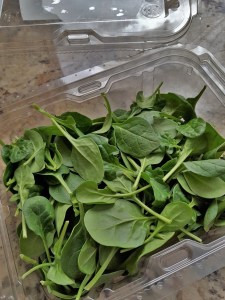
Spinach containerFortunately, my leafy-greens armoury is a stout one.  And I’ve learned to view every dish as a possible repository for foliage.  Greens thrown on sandwiches.  Tucked into tacos.  Stirred into soup.  Or curry.  Or eggs.  Or stirfries.

Let’s not forget that, sautéed with a few spices or a handful of favourite garnishes, they can make a tasty side dish on their own.  My first sampling of the Sautéed Kale Salad at the former Ox & Angela’s restaurant in Calgary (now Ox Bar de Tapas) made me a firm believer in that.  Consider combinations like these with whatever greens you have on hand (and a little garlic to amp up the flavour):

  • half a jar of roasted peppers or sundried tomatoes; garnished with goat cheese;
  • shallots or red onions fried with bacon or pancetta;
  • yellow onions sizzled with cayenne; topped with sesame seeds and a drizzle of sesame oil.

My favourite go-to is perhaps the easiest:  swiss chard fried up with garlic, salt, and hot pepper flakes and served with a squeeze of lemon.

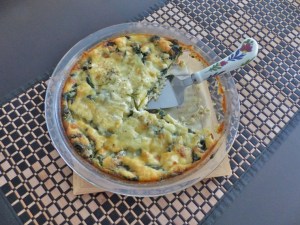
The biggest trick is to leave the container of greens front-row-centre in my fridge where I won’t forget it.  I almost lost track of mine this week after a couple of lacklustre side salads.  But I scavenged it in time, and the remainder anchored a nutrient-dense frittata served up for my supper with some good bread.

Here’s the frittata recipe that saved the day (with a basic egg-and-cheese base into which you can dump pretty much anything).  Feel free to add it to your personal leafy-green recipe arsenal.

And if you’ve got some great strategies of your own, please do share (at the bottom of this post).  Or write to me with your biggest leftovers millstones and I’ll address them in future posts if I can.

In the meantime, keep a steady eye on your Black Box – and watch for me next week.


SPINACH FRITTATA

Serves 4
Spinach frittata

1 Tbsp (15 ml) butter or vegetable oil

1/2 cup (125 ml) onion

2 garlic cloves, minced

6-8 handfuls of baby spinach (if you have less, that’s fine)

Pinch of nutmeg


Egg Mixture

8 eggs

1/4 cup (50 ml) milk

1/2 tsp (2 ml) salt (use less if your cheese is salty)

Black pepper to taste

1-2 cups (250-500 ml) of your choice of cheese(s)


Preheat oven to 350F (180C).  Grease a 9-inch (23 cm) glass pie plate and place on a baking sheet (to catch any drips).

Heat oil or butter in a large skillet over medium-high heat.  Add onion; cook until soft.

Stir in cloves, spinach, and nutmeg and cook until spinach is wilted.  Remove from heat.

In a large bowl, combine egg mixture ingredients.  Stir spinach mixture into bowl.

Pour into prepared pie plate; stir to distribute ingredients evenly.

Bake in centre of oven until top is golden and centre is set.


Text and photos © 2018 Catherine Van Brunschot
Black box